
Why Strong Positioning Reduces Sales Cycles For Workday Firms
The Problem No One Names
There is a particular kind of conversation that founders and BD directors of Workday consulting firms dread. A buying organisation has been in touch. Early signals look promising. A discovery call happens. The energy feels right. And then nothing. Weeks pass. The contact goes quiet. A follow-up gets a polite holding response. Another follow-up gets silence.
Most firms attribute this to procurement delays, internal politics, or budget cycles. Some of that is true. But a large proportion of these stalled conversations die for a different reason: the buying organisation was never fully clear on what they were buying.
Not because the firm failed to explain its services but because the firm failed to establish, before the conversation began, why it specifically was the right firm for this type of problem. In the absence of that clarity, buyers default to comparison. And comparison extends timelines.
This is the mechanism. Not budget. Not timing. Positioning ambiguity communicated silently through a generic profile, a vague website, a service list that sounds like every other Workday partner creates friction in the buyer's mind before a single conversation takes place.
How Workday Buyers Actually Shortlist
Understanding why positioning accelerates decisions requires understanding how Workday buying decisions are actually made.
Workday implementations are high-stakes engagements. A mid-market HR transformation programme represents material risk for the HR Director sponsoring it, the CFO funding it, and the business units depending on it. These buyers do not shortlist casually.
Research consistently shows that senior buyers in enterprise technology particularly in high-trust professional services complete the majority of their evaluation before any vendor contact. Gartner's analysis of B2B technology buying cycles shows that buyers are 57 to 70 percent of the way through their decision process before engaging directly with a vendor. For Workday services specifically, this silent research phase is longer, because the stakes are higher and the options appear more similar on the surface.
During this phase, buyers are not reading sales decks. They are observing. They are reading LinkedIn content produced by consultants and partners. They are assessing whether a firm's published thinking demonstrates fluency with their actual problem not generic Workday expertise, but specific, contextualised understanding of the type of transformation they are navigating.
LinkedIn functions as a due diligence layer. According to LinkedIn's own B2B Institute research, 75 percent of B2B buyers use LinkedIn to inform purchasing decisions. For professional services firms with no physical products to evaluate, the digital presence and specifically the quality of LinkedIn authority becomes a primary trust signal.
What creates positive shortlisting signals: demonstrated expertise in a specific Workday domain or sector, evidence of outcomes achieved for similar organisations, and consistency of perspective over time. What creates resistance: a presence that positions the firm as capable of everything, available to anyone, with no clear point of view.
The Core Insight: Positioning Is A Buying-Time Variable
Most Workday consulting firms treat positioning as a marketing concern. It is not. Positioning is a commercial variable one that directly affects the length and efficiency of buying cycles.
Here is why this distinction matters.
When a firm has clear, specific positioning a defined sector focus, a named area of Workday expertise, a consistent point of view about how a particular type of transformation should be approached buyers arrive at conversations having already pre-answered a set of internal questions. They are not asking "is this firm credible?" They are asking "is this firm the right fit for our specific situation?"
That shift in the buyer's internal question is the difference between a six-week buying cycle and a six-month one.
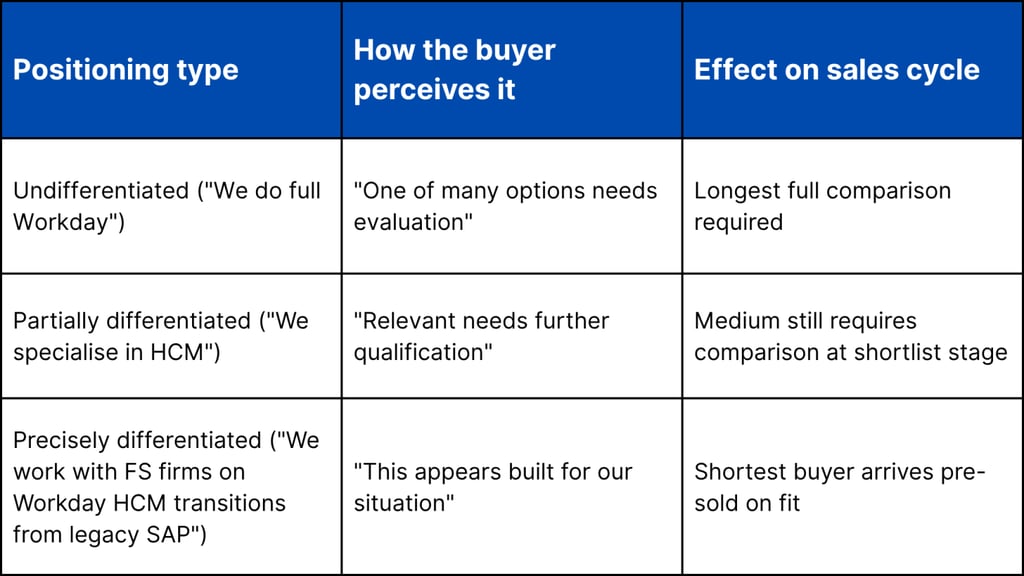
The Positioning Clarity Spectrum
Why Vague Positioning Creates Longer Timelines
A buyer who cannot place a firm clearly within their decision framework does not remove them from consideration they move them to a mental holding category while the evaluation continues. This is not a conscious decision. It is cognitive load management. Clarity reduces load. Ambiguity increases it.
The firms that close contracts faster are not always the ones with the most compelling proposals. They are the ones whose positioning, established through consistent LinkedIn presence before any conversation, made the buyer feel that the fit was already confirmed before the negotiation began.
The Workday Market's Specific Positioning Problem
The Workday partner ecosystem is crowded with firms that describe themselves in functionally identical terms: "implementation," "AMS," "HCM," "Finance," "experienced team," "client-focused." These descriptions are accurate. They are also indistinguishable. From the buyer's perspective, evaluating five firms with identical surface-level positioning is cognitively costly and commercially risky. The firms that shorten this cost through clear, specific, consistently communicated positioning systematically win faster.
A Framework For Positioning That Accelerates Buying
What follows is not a LinkedIn strategy. It is a structured approach to the positioning decisions that precede LinkedIn activity because posting without clear positioning simply amplifies ambiguity at scale.
Step 1: Define the specific intersection
Strong positioning for a Workday firm sits at the intersection of: a specific Workday domain (HCM, Finance, Payroll, Integrations), a specific buyer type (HR Directors in mid-market manufacturing; CFOs in regulated financial services; IT leaders in NHS-adjacent health organisations), and a specific transformation context (legacy SAP migrations; post-merger harmonisation; first-time Workday deployments). If your positioning cannot name all three clearly, buyers cannot place you quickly.
Step 2: Identify the signal, not just the service
The buyer researching your firm is not looking for a service description. They are looking for evidence that you understand their situation. This means your LinkedIn content, your articles, your commentary should demonstrate fluency with the specific tensions buyers in your sector face not generic Workday feature explanations. A post about "why mid-market manufacturing firms consistently underestimate Workday Payroll localisation" is a positioning signal. A post about "top five things to know about Workday HCM" is not.
Step 3: Establish consistency before reaching for volume
A firm that publishes one well-positioned piece of thinking per week for six months will outperform a firm that produces daily content with no clear point of view. Buyers conducting silent research do not reward frequency they reward coherence. The question to ask of every piece of content: does this deepen or dilute our positioning?
Step 4: Audit the baseline
Before any content strategy, audit what your LinkedIn presence currently communicates to a senior buyer who encounters it for the first time cold, with no prior knowledge of your firm. What do they conclude about who you work with, what you are best at, and what point of view you hold? If the answer is "nothing specific," the positioning work precedes the content work.
Why Patience In Positioning Is A Commercial Advantage
There is a temptation, particularly in a competitive consulting market, to keep positioning broad. The logic is understandable: the wider the net, the more opportunities. In reality, broad positioning extends every sales cycle because it forces buyers to do evaluation work that clear positioning would have already done for them.
The firms that build repeatable, efficient pipeline are the ones that accept a narrower initial claim in exchange for a faster, higher-conversion buying journey. Clarity, consistently maintained, compounds. A Workday consulting firm with precise positioning and consistent LinkedIn presence does not just attract more relevant enquiries it attracts buyers who arrive partially pre-sold. That is not a marketing outcome. It is a commercial one.
If you lead a Workday consulting firm and are not certain whether your current LinkedIn presence is helping or slowing the buying decisions already in progress, the Workday LinkedIn Audit is a structured diagnostic designed to answer that question. It is offered to a small number of firms each quarter. If you would like to understand what it covers and whether it would be relevant for your firm, reach out directly.