
Why AMS Is Easier To Sell Than Implementations If You Position It Correctly
The Problem Most Workday Consulting Firms Don't See
Walk into almost any Workday consulting firm and ask how they win AMS work. The answer is usually some version of: we follow up with implementation clients, we stay in touch, we wait.
That is not a pipeline. That is a hope.
The structural problem is not effort. It is positioning. Most Workday consulting firms market their AMS offering the same way they market implementations as a project, a capability, a team you bring in. The copy is about what they do. The promise is about delivery quality. The pitch deck has a service description where the client's problem should be.
And then they wonder why AMS feels transactional, why buyers discount it against body-shop competitors, and why retaining clients beyond the first post-go-live period is harder than it should be.
The irony is that AMS, positioned correctly, is structurally easier to sell than an implementation. The buyer is already in the system. The risk of switching is real and quantifiable. The value of continuity is something the buyer has already experienced firsthand. None of that is true in an implementation sale. You have to build all of it from scratch.
The firms that lose AMS mandates are not losing on capability. They are losing at the positioning stage before the conversation even begins.
How Workday Buyers Actually Research AMS Partners
HR Directors and CFOs do not wake up thinking about AMS. They wake up thinking about a payroll error that happened last quarter, an integration that keeps breaking on release updates, or a reporting layer that the finance team has stopped trusting.
What they search for often without calling it research is evidence that someone else has solved their specific version of the problem. They read articles. They check LinkedIn profiles. They look at who their peers follow and what those people post. They watch how a firm shows up consistently around the issues that are live on their desk.
This is the silent shortlisting process. LinkedIn's own data on B2B buying behaviour consistently shows that enterprise buyers complete most of their evaluation before speaking to a vendor. Gartner research on complex B2B purchases identifies that buyers spend more time with self-directed digital research than with any single sales interaction. What this means in practice for Workday AMS is that the firms being shortlisted are the ones who show up credibly in the spaces buyers are already in well before a request for proposal is issued.
LinkedIn functions as a due diligence tool in this context, not a social network. A buyer seeing a director or principal at your firm posting consistently about Workday release management, HCM configuration challenges, or integration failures reads that as competence in action. A buyer who sees nothing reads that as absence of opinion which reads as absence of expertise.
The window to influence a buying decision opens early and closes quietly. Most Workday consulting firms are not in the room when it matters.
The Core Insight: AMS Is A Certainty Sale, Not A Capability Sale
This is the positioning shift that changes everything.
An implementation is, by nature, a capability sale. The buyer is asking: can you do this? They are comparing firms on technical depth, team size, methodology, and delivery track record. The evaluation is rigorous because the stakes are high and the buyer has no prior relationship to draw from.
AMS is different. The buyer is not asking whether you can manage their Workday environment. They already know the answer, or they assume it if you passed the implementation, you can run the AMS. What they are actually evaluating is certainty: will this arrangement be reliable enough that I do not have to think about it?
That is a fundamentally different question. And it requires a fundamentally different positioning response.
What a capability sale looks like in AMS positioning:
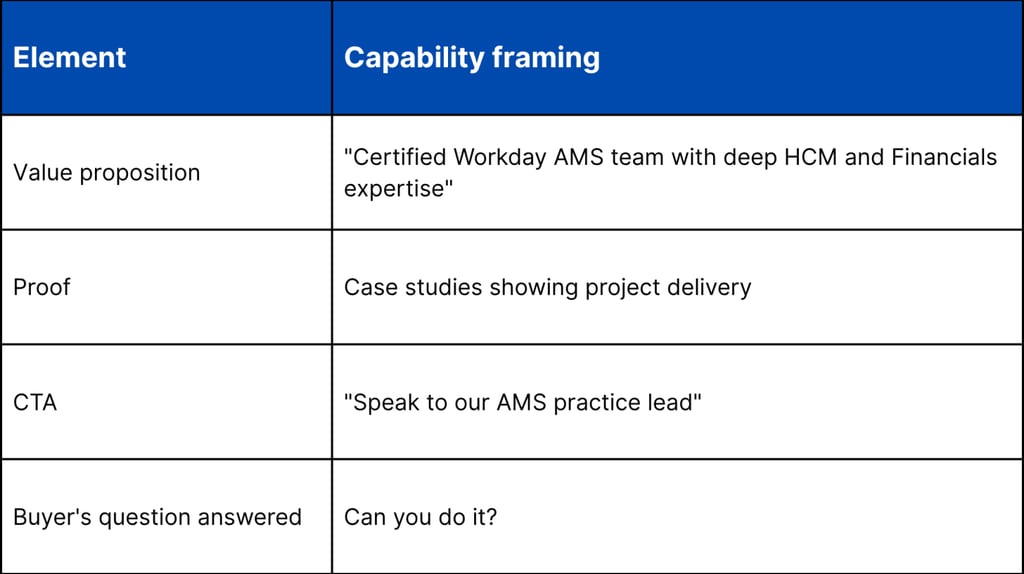
What a certainty sale looks like:
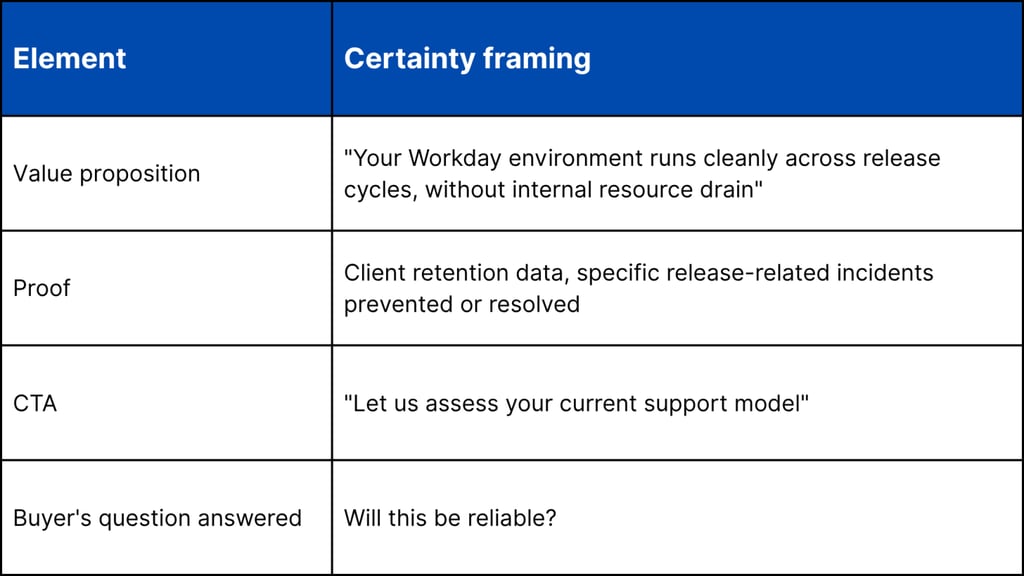
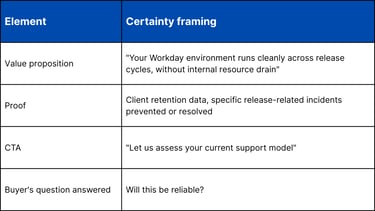
The firms that win AMS mandates consistently have moved, consciously or not, into certainty framing. They do not lead with their team or their certification. They lead with what the buyer's world looks like after the arrangement is in place.
The subtext of great AMS positioning is: you will not have to worry about this. That is the purchase. Not a team. Not a contract. Not a service tier.
A Framework For AMS Positioning That Creates Pipeline
The following framework is designed for Workday consulting firms that want to move from reactive AMS sales following up with implementation clients and waiting to a positioning-led approach that generates warm inbound consideration before any outreach begins.
Step one: Define the failure state your AMS prevents
Before positioning anything, your firm needs to be specific about the exact operational problem you solve. Not Workday AMS support in general a specific failure that your ideal client is either experiencing or anxious about. Examples: payroll discrepancies triggered by a Workday release update. Reporting failures caused by tenant configuration drift. Integration breaks that the internal IT team cannot diagnose because they lack Workday-specific knowledge.
The more precisely you name the failure state, the more clearly a buyer recognises themselves in your positioning.
Step two: Map your proof to the certainty frame, not the capability frame
Take every client reference, case study, and outcome you currently use in sales conversations. Reframe each one around certainty. The question is not "what did we deliver?" but "what did the client stop worrying about?" If you cannot answer that question, go back to the client and ask.
Step three: Build a consistent LinkedIn presence around the failure states, not the firm
This is where most firms get it wrong. They post about their team, their accreditations, their service tiers. Buyers do not care about any of that at the shortlisting stage. They care about whether you understand their world.
Posting consistently about the operational realities of managing a live Workday environment release cycles, tenant hygiene, integration architecture, reporting dependencies positions your firm in exactly the space buyers are searching. This is not thought leadership for its own sake. It is category presence that makes you findable before buyers start asking around.
Step four: Systematise client retention as a positioning proof point
Your longest-standing AMS clients are your most powerful positioning asset. Not because you can name them publicly, but because the pattern of long-term retention when stated accurately signals certainty to a new buyer more effectively than any capability claim.
"We have maintained ongoing Workday support relationships with our clients for an average of three-plus years" is a more compelling certainty signal than any service description you could write.
Your Next Step
Workday AMS mandates are won or lost before the proposal. Buyers form a shortlist based on who they already trust and trust is built through consistent, credible visibility in the spaces where buyers are already paying attention.
The firms that compete on capability alone will always be evaluated on price and compared against lower-cost alternatives. The firms that position around certainty making the buyer's operational anxiety the centrepiece of their communication create a category of one.
Consistency is not a content strategy. It is a commercial strategy. The firms that understand that distinction will build AMS pipelines that grow on their own terms, not on the terms of whatever implementation cycle is finishing this quarter.
If you are a founder or director of a Workday consulting firm and you are unsure whether your LinkedIn presence is helping or working against you in active AMS buying decisions, the Workday LinkedIn Audit is a 20-minute diagnostic designed for exactly that conversation. It is available to a limited number of firms each month. You can request yours via the link in my profile.