
The Silent Research Phase: Why Workday Buyers Have Already Chosen Before They Call
The Problem You Haven't Named Yet
Picture this. A transformation director at a mid-sized financial services firm has just received board sign-off on a Workday HCM implementation. Before she forwards a single email or requests a shortlist from procurement, she opens LinkedIn.
She types a few things into the search bar. She visits three or four company pages. She scrolls through the profiles of the people leading those firms. She reads a post or two. She checks who her network knows.
Twenty minutes later, she has a mental shortlist. One firm feels credible. Two feel generic. One she's never heard of.
That twenty minutes just decided your pipeline and you weren't in the room.
This is the pattern destroying pipeline for Workday consulting firms right now. Not bad outreach. Not weak proposals. Not price. The real problem is that most firms are invisible during the phase that matters most: the anonymous research window before any conversation starts.
It doesn't feel like a problem because there's no signal. No form submission. No email open. No LinkedIn view that triggers a CRM alert. The buyer does their research, forms a view, and only then contacts the firms they've already decided to trust. If you weren't visible and credible during that window, you were never on the list. The call you're waiting for never comes.
How Workday Buyers Research Without Telling You
The scale of the silent research phase is no longer speculative. The data is direct and consistent across multiple research bodies.
According to 6sense's 2024 Buyer Experience Report, 81% of buyers have a preferred vendor at the time of first contact, and 85% have already established their purchase requirements before reaching out. Think about what that means for your BD team. By the time someone replies to your outreach or books an intro call, they have almost certainly already decided whether they trust you.
Forrester's 2024 Buyers' Journey Survey found that even among first-time buyers, half enter the buying process with a preferred vendor already in mind and among solo decision-makers, 63% begin with a single vendor already chosen.
Forrester's conclusion is stark: "B2B buying today is a process of confirmation, not selection."
For Workday consulting specifically, this matters more than in almost any other professional services category. Workday implementations are high-stakes, multi-year commitments involving internal change management, sensitive HR and finance data, and board-level visibility. Buyers do not select Workday partners the way they select software vendors. They select them the way they select surgeons. They want to know who you are, how you think, what you've done, and whether people they respect have vouched for you before they ever agree to a meeting.
LinkedIn is where that due diligence happens. A buyer visiting your firm's profile is not browsing. They are running a quiet background check. They are asking: does this firm understand firms like ours? Do their people publish anything worth reading? Do their leaders communicate like professionals I'd want in the room with my board? Do their clients look like us?
If the answers are unclear, uncertain, or absent, the buyer moves on. Silently.
The Core Insight: LinkedIn As Buyer Infrastructure, Not Marketing Channel
Most Workday consulting firms treat LinkedIn as a place to broadcast news. New hire announcements. Award acknowledgements. The occasional thought piece that took three hours to write and received forty-two impressions.
This is a fundamental misread of how the platform works in a buying context.
LinkedIn is not where Workday buyers go to be marketed to. It is where they go to form trust judgements. The distinction sounds subtle. It changes everything.
Here is the difference in practice:
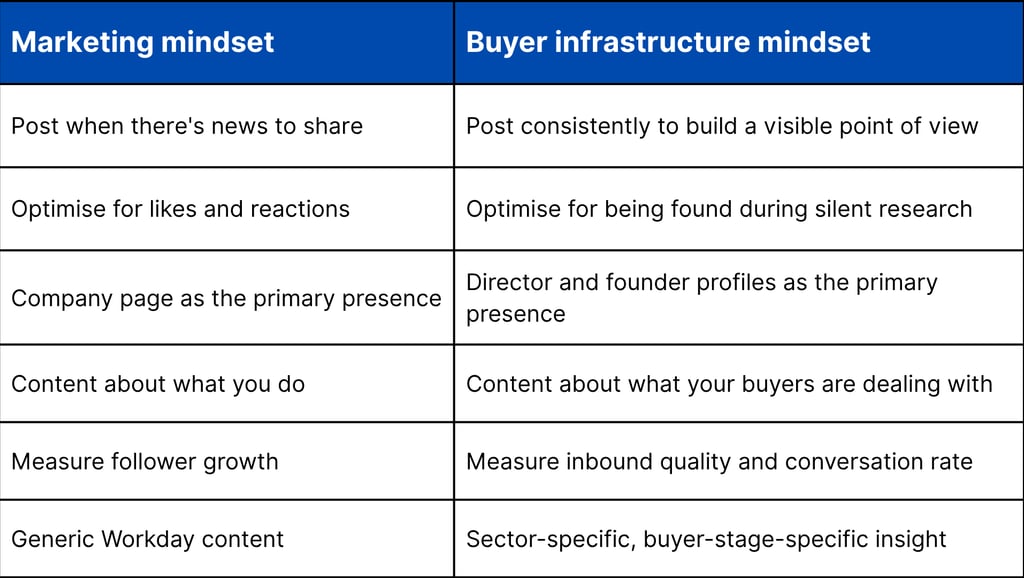
The firms generating consistent, inbound pipeline from LinkedIn are not the ones with the most polished content. They are the ones whose directors publish regularly, whose positioning is unambiguous, and whose content addresses the specific problems a buyer is sitting with not the features of a service offering.
Why director profiles outperform company pages
When a buyer runs a quiet background check, they do not want to read a company's version of itself. They want to form a view of the people they would actually be working with. A director who publishes twice a week about Workday integration challenges, post-go-live support models, or the realities of AMS delivery tells a buyer far more than any brochure.
This is why LinkedIn-led pipeline generation for Workday firms is a profile-first strategy. The company page matters. The people behind it matter more.
Why sector specificity is the deciding signal
Workday buyers are not generic. A finance transformation director at a housing association has different pressures, different language, and different concerns than a CHRO at a professional services firm. Generic Workday content reads the same to both and resonates with neither.
The firms that win the silent research phase are the ones whose content makes a buyer think: these people understand my world specifically. That is not achievable with general HR technology commentary. It requires deliberate, sector-aware positioning.
A Framework For Becoming Visible In The Research Phase
The goal is not to be everywhere. It is to be present, credible, and specific in the places your buyers look when they are deciding quietly who to trust.
Here is a structured way to approach it.
Step 1 — Define your research-phase presence
Ask one question: if a transformation director at a target account looked at your firm's LinkedIn presence today, what conclusion would they draw in under three minutes? Not about your services. About your credibility.
Audit the director profiles, the company page, and the last thirty pieces of content published. Does anything there speak directly to the problems a Workday buyer is carrying right now? If the honest answer is no, that is where the work starts.
Step 2 — Establish a point of view, not a service description
A point of view is an opinion about how something should be done. It is specific, arguable, and memorable. A service description is a list of capabilities. Buyers do not shortlist firms because of their capability lists. They shortlist firms because someone said something that made them think: yes, that's exactly right.
Choose two or three specific positions your firm holds on Workday implementation, AMS delivery, or post-go-live support. Make them visible. Repeat them consistently.
Step 3 — Build a publishing rhythm, not a content calendar
A content calendar produces content. A publishing rhythm produces presence. The distinction is whether your team is creating posts to fill a schedule or creating posts because there is something worth saying to a specific buyer audience.
Aim for director-level publishing at a minimum of twice per week. Make each piece address a recognisable problem, challenge, or decision your buyers face. Not Workday feature updates. Not internal milestones. Buyer-facing insight.
Step 4 — Treat your newsletter as a trust asset
If you do not have a LinkedIn newsletter, you are missing the highest-leverage long-form channel available on the platform. A newsletter builds a direct subscriber relationship with buyers who have opted in to hear from you. That is a different relationship than the passive scroll. It is pre-qualified attention from people who decided your perspective was worth following.
Build it around a single theme. Publish consistently. Write for the buyer's intelligence, not their attention span.
Step 5 — Audit for friction, not just absence
The most common LinkedIn problem for Workday consulting firms is not that they are absent. It is that their presence creates friction. Vague positioning, outdated experience sections, content that reads like internal communications dressed for public consumption, or company pages that look identical to thirty other Workday partners.
Friction in the research phase is invisible damage. The buyer moves on and you never know why.
Your Next Step
The firms that win the next generation of Workday pipeline will not win it by outreaching harder. They will win it by being the firm a buyer has already formed a positive view of before any conversation begins.
That is not a function of advertising spend, a larger BD team, or a better pitch deck. It is a function of how consistently and specifically you show up in the places your buyers look when they are deciding quietly, anonymously, and with the deal already half-formed in their head.
The research phase is where trust is built or lost. Most firms are not there. That is the opportunity.
A note for founders and directors
If you are unsure whether your current LinkedIn presence is helping or creating friction in the way your buyers research and evaluate you, the Strategic Audit (£400) is a structured diagnostic I run for Workday consulting firm leaders. It examines your positioning, director profiles, content signals, and how your presence reads to a buyer running due diligence. No guarantees, no pitch a professional diagnostic for firms that want to understand where they stand before they invest further. If that is relevant to your situation, connect with me directly.