
The Hidden Shortlist: Why Buyers Decide Before You Ever Pitch
The Decision Has Often Already Been Made
There is a moment in most Workday consulting sales processes that feels like the beginning the discovery call, the RFP response, the first conversation with a Head of HR or Finance Director.
It is rarely the beginning.
By the time a senior buyer agrees to speak with you, they have typically spent weeks sometimes months building their own picture. They have read LinkedIn posts. They have looked at who their peers follow. They have noticed which firms keep showing up with credible perspectives on Workday implementations, AMS contracts, or the latest platform releases.
That pre-conversation period is where the shortlist is built.
And if your firm is not visible during that period, it is almost certainly not on the list.
How Buyers Actually Research Workday Partners
Understanding this requires understanding how HR and Finance leaders make vendor decisions not how salespeople assume they do.
According to Gartner's research on B2B purchasing behaviour, the average enterprise buying group spends only 17% of their total purchase journey in direct contact with suppliers. The remaining 83% is spent on independent research, internal discussions, and peer consultation.
LinkedIn's B2B Institute has found that buyers are, on average, 70% through their decision-making process before they make first contact with a vendor.
This is not a digital marketing statistic. It is a commercial reality that changes how Workday consulting firms should think about pipeline development entirely.
The firms that win are not necessarily the ones that pitch the best. They are the ones that were already trusted before the pitch began.
The Architecture of a Hidden Shortlist
When a CPO, CFO, or CHRO begins evaluating Workday implementation or AMS partners, they rarely start with a Google search. They start with memory and social proof.
Memory: Which firms have they already seen discussing Workday in a credible, non-promotional way? Which voices on LinkedIn made sense when they were trying to understand a Workday release, a common implementation pitfall, or the realities of change management?
Social proof: Which firms do peers in similar roles reference? Which consultancies appear in discussions within professional communities, industry events, or shared networks?
Perceived fit: Does this firm appear to understand our sector, our size, our likely challenges before we've even spoken?
These three filters happen before any formal evaluation process begins. They happen passively, through exposure over time. And they determine who gets considered seriously once buying intent becomes active.
What Most Workday Firms Get Wrong on LinkedIn
Most Workday consulting firms approach LinkedIn as a selling channel. The posts announce new accreditations, share job openings, and occasionally congratulate clients on go-live milestones.
This is not visible. It is simply present.
There is a fundamental difference between a firm that exists on LinkedIn and a firm that builds authority on LinkedIn. The difference is not volume of activity. It is the consistent delivery of perspective that buyers find useful before they are ready to buy.
McKinsey research on B2B sales and trust notes that buyers are significantly more likely to engage with vendors they perceive as knowledgeable, even when competitor pricing is lower. In consulting, where outcomes are difficult to evaluate before engagement, perceived expertise is often the primary decision lever.
The problem is that perceived expertise cannot be built in a campaign. It accumulates slowly, through repeated exposure to thinking that helps buyers do their jobs better.
The Three Pillars of LinkedIn Authority for Workday Firms
Building a presence that earns you a place on hidden shortlists requires consistent work across three areas.
1. Positioning Clarity
Before a buyer can place you on their shortlist, they need to be able to categorise you clearly. A Workday firm that tries to be visible across every module, every sector, and every geography ends up being memorable in none.
The most effective positioning narrows the field deliberately. It says, in effect: if you are a mid-market professional services firm considering a Workday HCM implementation, this firm understands your context specifically.
Clarity of positioning is not a marketing exercise. It is a commercial decision that shapes everything visible the content, the conversations, the client references, and the inbound enquiries you attract.
2. Content as Infrastructure
The second pillar is content that functions as infrastructure rather than noise.
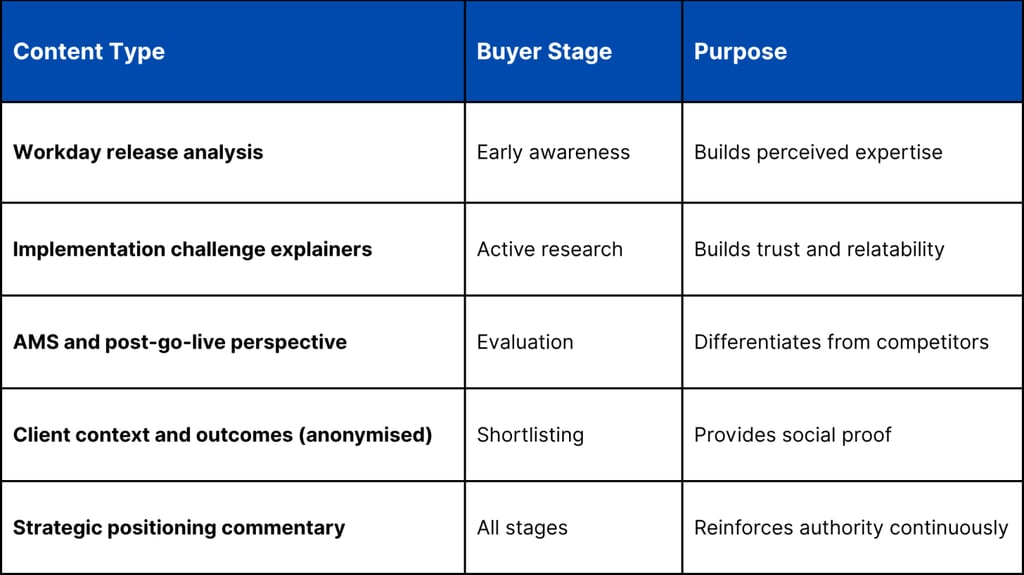
Infrastructure content answers the questions that buyers are genuinely asking at different stages of their evaluation. It addresses the anxieties that senior leaders have about Workday implementations cost overruns, change management failures, AMS quality after go-live, data migration complexity. It speaks to the real decisions that HR and Finance leaders face when scoping a Workday programme.
This content does not need to go viral. It needs to be consistently excellent and consistently visible to the right audience over time.
According to HBR research on thought leadership effectiveness, the primary reason buyers trust a vendor's expertise is sustained, specific engagement with their real challenges not broad, polished content marketing.
The implication for Workday firms is significant. One post per week, published consistently over twelve months, on topics that genuinely matter to HR and Finance buyers, will do more for pipeline development than a campaign that runs for six weeks and then stops.
3. Network Activation
The third pillar is ensuring that your content reaches the right accounts not just your existing connections.
LinkedIn's algorithm favours content that generates meaningful engagement, particularly from first-degree connections with professional credibility. This means that the quality of your network matters as much as the quality of your content.
Deliberately building a network that includes HR Directors, CFOs, Workday project leads, and procurement professionals in your target sectors creates the conditions for your content to circulate in the right conversations.
This is not about connection requests to strangers. It is about sustained participation in professional discussions, thoughtful commentary on relevant content, and consistent presence in the communities where your buyers spend their time.
The Sales Conversation You Want to Have
When pipeline development is working properly through LinkedIn, the nature of sales conversations changes.
Instead of introducing your firm and your capabilities, you are having a conversation that begins somewhere deeper. The buyer already has context. They have seen your perspective on a Workday issue that was relevant to them. They have formed a view that you understand their space.
The sales work that remains is qualification and fit assessment not education and credibility-building from scratch.
This is not a minor efficiency gain. It is the difference between a competitive pitch that depends on performance, and a conversation where trust is already substantially in place.
A Practical Checkpoint
Before closing, it is worth asking the question honestly:
If a Head of HR at a 2,500-employee professional services firm spent 30 minutes on LinkedIn looking for Workday implementation partners this week, would your firm appear? Would what they found give them confidence that you understand their context and their challenges?
If the honest answer is no or uncertain that is the gap worth closing.
Not through activity for its own sake. Through a deliberate, structured approach to building LinkedIn visibility that earns trust before the first conversation begins.
Working With the Right Firms
I work exclusively with Workday consulting firms to assess where their LinkedIn presence is helping pipeline development and where it is creating unnecessary friction.
If you are a founder or director of a Workday consulting firm and you are unsure whether your current LinkedIn activity is building the kind of authority that supports sales conversations, a Workday LinkedIn Audit is a useful starting point.
It is not a sales process. It is a structured assessment of positioning clarity, content infrastructure, and network reach with a clear picture of where the gaps are and what addressing them would realistically involve.
If that is relevant to where you are, you are welcome to reach out directly.