
From Founder-led Sales To Team-led Growth: The Transition Most Workday Firms Avoid
THE PROBLEM
Picture this. A Workday consulting firm turns over £3–5 million. The MD is visible, well-networked, and credible. When they are in the room, deals move. When they are not, they stall.
The firm has three to four consultants who could, in theory, carry some of that relationship load. But they are heads-down on delivery. No one is nurturing the accounts in the pipeline. No one is publishing anything that signals the firm's thinking. No LinkedIn activity. No consistent outreach. No commercial presence beyond the MD's name.
This is not a sales problem. It is a structural problem disguised as a capacity problem.
The MD is the firm's demand engine. And the MD is not a scalable asset.
What happens when they take two weeks off? When a major delivery crisis pulls their attention? When they are in back-to-back project reviews for a quarter? Pipeline stalls. Introductions dry up. The firm becomes invisible to the accounts it should be building relationships with right now.
Most Workday consulting firms recognise this pattern. Very few do anything about it. Not because they lack ambition but because the solution feels vague, and the business is busy.
This article is for the MD or BD director who knows something needs to change, but has not yet found a clear way to think about it.
THE BUYER'S HIDDEN PROCESS
Before any Workday buyer picks up a phone or sends a request for information, they have already formed a view.
According to Forrester's B2B Buying research, 68% of B2B buyers prefer to conduct independent research before engaging with a vendor directly. In enterprise software and implementation services where Workday sits that number skews higher. Buyers are evaluating complexity, risk, and fit long before they raise their hand.
LinkedIn is where a significant part of that research happens. Not to look at company pages. To look at people.
When a Workday programme manager, procurement director, or IT lead starts researching delivery partners, they are looking at the LinkedIn profiles of founders and senior consultants. They are checking whether those individuals have a point of view. Whether they sound like practitioners or salespeople. Whether the firm's content matches the type of problem the buyer is trying to solve.
The Edelman-LinkedIn B2B Thought Leadership Impact Study found that 58% of decision-makers award business to companies based on thought leadership even when those firms were not on their original shortlist.
That shortlisting happens silently, months before outreach.
Here is what triggers buyer resistance: a firm that looks active on the surface a company page with posts, a polished website but whose team members are invisible individually. Buyers read this as a firm with something to hide, or a firm that does not believe in what it sells.
Trust is built through people, not logos. If only one person at your firm has a credible LinkedIn presence, your pipeline is one person deep.
THE CORE INSIGHT
The founder is not the problem. The dependency is.
Founder-led sales is a feature in the early stages of a consulting firm. Your name and relationships are the proof of concept. But after a certain threshold typically when the firm passes 15–20 people, or when it is targeting a consistent pipeline of £1M+ per year founder dependency stops being a strength and starts being a ceiling.
The transition to team-led growth is not about removing the founder from the equation. It is about building pipeline infrastructure that functions whether the founder is present or not.
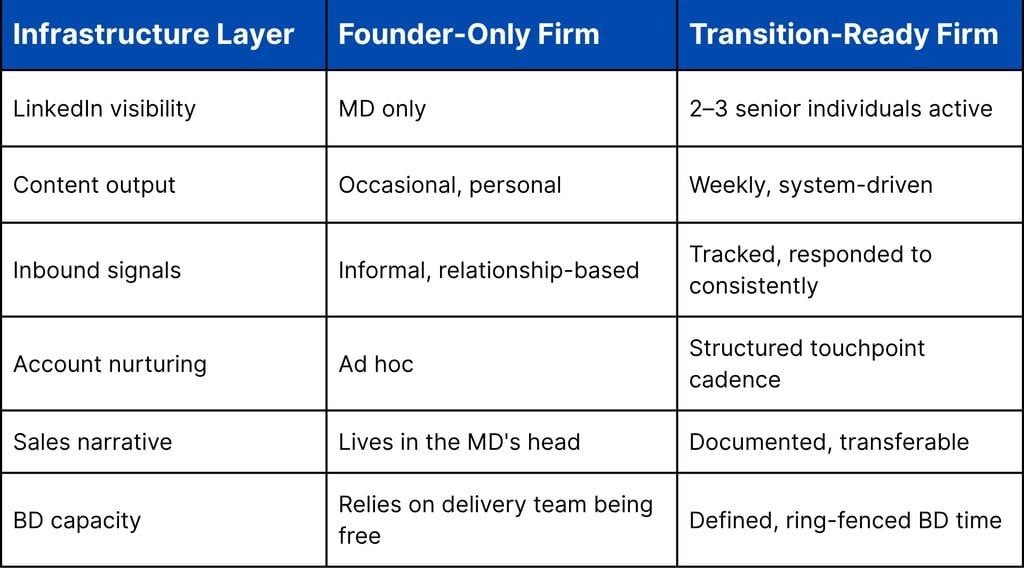
Here is what that infrastructure actually looks like in practice:
The gap most firms do not see
When we audit Workday consulting firms' LinkedIn presence, the pattern is consistent. The MD has 3,000–8,000 connections, occasional posts, reasonable engagement. Every other team member has a dormant profile, a default headline, and no visible activity.
The firm's buyers who are doing their due diligence see a one-person brand. That carries implicit risk: what happens if this person moves on? What does the firm actually look like at the delivery level?
Your people are proof of your capability. If they are invisible, your capability is invisible.
THE PRACTICAL FRAMEWORK: THE THREE-LAYER PIPELINE INFRASTRUCTURE MODEL
Transitioning from founder-led to team-led pipeline is not a campaign. It is an infrastructure build. Here is a structured way to approach it.
Layer 1 — Visibility architecture (Months 1–2)
Define which two to three individuals in your firm should become commercially visible. Not everyone. The right people: senior consultants, practice leads, or client directors who are closest to buyer problems. Rebuild their LinkedIn profiles around outcomes, not CVs. Each person needs a clear positioning statement, a visible area of expertise, and a consistent content angle.
Layer 2 — Content infrastructure (Months 2–4)
The firm needs a content engine that does not depend on the MD finding time to write. That means a defined content calendar, a repeatable production process, and content that maps to the stages of how Workday buyers think: awareness of a problem, evaluation of options, trust in a specific firm. Content at each stage serves a different function. Mixing them up creates noise instead of pipeline signal.
Layer 3 — Signal capture and response (Ongoing)
Most Workday firms have more inbound interest than they realise. Profile views, post engagement, connection requests from relevant accounts these are soft signals that the market is paying attention. The question is whether the firm has a system to track, qualify, and respond to those signals before they go cold. This is not automation. It is attentiveness. A weekly review of who is engaging with your content and your team's profiles, and a disciplined outreach response, is enough to create a meaningful pipeline layer that did not exist before.
None of these layers require significant headcount. They require design, consistency, and a clear separation between content activity and sales activity.
YOUR NEXT STEP
The firms that will build the most durable Workday consulting practices over the next three to five years are not necessarily the largest. They are the ones that figured out how to make their expertise visible at scale, without depending on a single person to carry that weight.
Founder-led sales got you here. It will not get you to the next stage.
The pipeline your firm needs in twelve months is being built or not built right now. Not by what you are quoting, but by how visible and credible your team looks to the buyers who are quietly doing their research.
That research is happening whether you are ready for it or not.