
From Founder-led Sales To Team-led Growth
The Problem Most Workday Consulting Founders Will Not Say Out Loud
There is a pattern that repeats itself across Workday consulting firms at the £2M–£10M revenue mark.
The founder is good at sales. Exceptionally good, in many cases. They know the market, they know the language, they know how to read a room with an HR Director or CFO. So the firm grows not because of a system, but because of a person.
Then something shifts. The founder gets pulled into delivery. Or a major client demands more of their time. Or they simply want to step back from the front line.
And the pipeline quietly dries up.
This is not a sales problem. It is a structural problem. The firm never built a pipeline that could function without the founder at its centre. Every warm conversation, every referral, every RFP that arrived uninvited it came through one person's reputation, one person's relationships, one person's presence on a call.
The mechanism is not bad luck or poor timing. The firm built revenue on personal authority rather than institutional authority. Those are not the same thing, and the difference only becomes visible when the founder steps back.
How Workday Buyers Actually Make Shortlisting Decisions
Before any buyer sends a brief, books a call, or acknowledges they are even in a buying process, they have already done substantial research.
This research is almost entirely invisible to vendors.
Workday buyers typically HR Directors, CFOs, Heads of People Technology, or Heads of Finance do not rely on cold outreach to find implementation or AMS partners. They ask peers. They search LinkedIn. They read content from people they have been quietly following for months. They compare how different firms talk about the same problem.
LinkedIn's own B2B research has consistently shown that the majority of the buying journey takes place before vendor contact. The Edelman-LinkedIn B2B Thought Leadership Impact Study has repeatedly found that senior decision-makers use thought leadership content to assess which vendors understand their specific context not just their category.
For Workday implementations, the evaluation is even more trust-sensitive than general enterprise software. The scope is large, the internal political stakes are high, and the switching cost after a failed implementation is significant. Buyers are not looking for the cheapest option. They are looking for the safest choice.
What makes a firm feel safe? Evidence that they understand the buyer's world. Evidence that they have done this before, in similar organisations. Evidence that the people who would run the project are credible, visible, and grounded in the real complexity of Workday environments.
If that evidence does not exist on LinkedIn across the firm's page, its founders, its directors, and its senior consultants the firm is simply absent from the shortlist. Not losing. Absent.
The Core Insight: Pipeline Infrastructure Is Not The Same As Pipeline Activity
Most Workday consulting firms have pipeline activity. They attend events. They run webinars. They ask consultants to post occasionally on LinkedIn. They send newsletters when capacity allows.
What they rarely have is pipeline infrastructure a system that produces consistent visibility and trust with the right accounts, regardless of who is available or what the founder is doing that week.
The distinction matters:
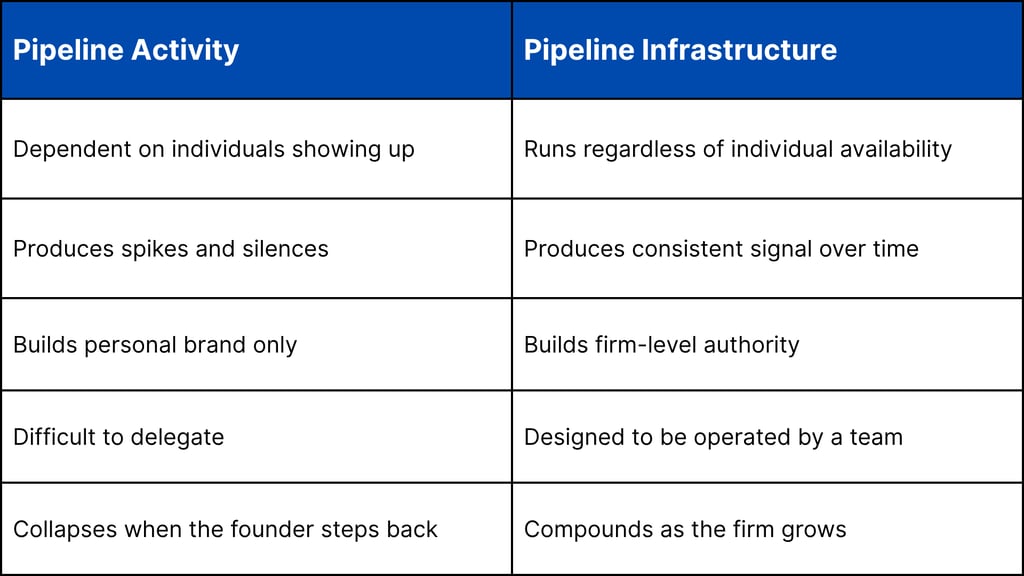
Why most firms stay in the activity column
Transitioning from activity to infrastructure requires accepting that results will be slower in the short term and more durable in the long term. Most firms, under revenue pressure, choose short-term activity every time.
There is also a subtler problem. Many founders assume their personal brand is the firm's brand. This is true at the early stage. But as the firm grows, this conflation becomes a ceiling. Buyers who need reassurance that the firm can deliver without the founder present at scale, across multiple projects will look for signals beyond the founder's LinkedIn profile.
What infrastructure actually looks like
Firm-level infrastructure has three components running in parallel:
First, the firm's LinkedIn presence communicates a clear, specific positioning not "we implement Workday" but a precise articulation of which organisations they serve, what problems they solve, and what makes their approach different from the thirty other Workday partners also bidding for the same work.
Second, two to three senior voices within the firm not just the founder publish consistently on topics that demonstrate deep, specific Workday expertise. Not engagement-bait. Not generic HR thought leadership. Content that would make a Head of People Technology say, internally, "These people understand our situation."
Third, the firm maintains active, structured visibility in the accounts it is targeting not cold outreach, but a sustained presence in the conversations its buyers are already having, so that when the buying moment arrives, the firm's name is familiar rather than foreign.
A Framework For Making The Transition
The shift from founder-led to team-led pipeline is not a rebranding exercise. It is an infrastructure build. Treat it accordingly.
Step 1: Audit what is currently producing pipeline
Before changing anything, map where your last five to ten client conversations actually came from. Referrals from whom? Content consumed by whom? LinkedIn profiles visited before first contact? Most firms, when they do this honestly, find that ninety percent of pipeline traces back to one or two people. That is the risk to address.
Step 2: Identify two or three senior voices beyond the founder
These do not need to be prolific content producers. They need to be credible and consistent. A Practice Lead, a Delivery Director, a Head of AMS someone whose name, when searched by a prospective buyer, returns evidence of genuine expertise. Consistency matters more than volume. Two posts per month, sustained over twelve months, outperform twenty posts in January and silence thereafter.
Step 3: Build firm-level positioning that does not depend on the founder's voice
Your company LinkedIn page, your website's core messaging, your team bios these should communicate a coherent positioning that holds together even if the founder's profile disappeared tomorrow. Most Workday firms, honestly assessed, fail this test. The page describes services. It rarely communicates the specific value the firm delivers to the specific buyers it serves.
Step 4: Define target accounts and build structured visibility
Infrastructure requires a target account list. Not a vague ICP a named list of organisations that fit your positioning, staffed by buyers you can identify on LinkedIn. Structured visibility means showing up in those accounts' worlds deliberately: relevant comments, shares of content they produce, responses to conversations they are already having. Not campaigns. Not automation. Deliberate, human presence at scale.
Step 5: Build a content calendar the firm can operate without the founder
If the founder is the only person who can approve, generate, or review content, you have not built infrastructure you have added another dependency. A functioning content system has templates, a point of ownership, and a review process that runs without founder involvement on a week-to-week basis.
Your Next Step
Founder-led firms are not broken. They are simply early-stage in their infrastructure maturity, regardless of how long they have been trading.
The firms that scale beyond £10M in Workday consulting revenue are not necessarily better at delivery or sharper in their proposals. They are more consistent in how they show up in the market before the buyer is ready to talk.
Building that consistency is not glamorous. It does not produce a spike in pipeline in the next quarter. It produces a market position that compounds quietly, durably over twelve to twenty-four months. That is the infrastructure most firms avoid building because the return is deferred. It is also the infrastructure that determines which firms are still growing in five years and which ones are still depending on one person to make the phone ring.
If you lead a Workday consulting firm and you are not certain whether your LinkedIn presence is building pipeline infrastructure or simply reflecting personal activity, a Workday LinkedIn Audit is worth considering. It is a structured diagnostic not a sales call for founders and directors who want a clear view of where they stand before committing to a direction. Available to a small number of firms each month.