
Certified Is Not Trusted: How Workday Buyers Separate Partners
The Problem Most Workday Firms Do Not Want To Name
There is a pattern that repeats across the Workday consulting market, and most firms experiencing it do not recognise it until a deal is already lost.
A firm earns its Workday partner certification. It builds a capable delivery team. It has case studies, a methodology, and a track record. And then it watches a less experienced competitor win the account.
The explanation partners usually reach for is price. Or relationships. Or luck.
The real explanation is almost always visibility specifically, the kind of visibility that builds trust before a buyer ever makes contact.
Certification tells a buyer that a firm can deliver Workday. It says nothing about whether that firm understands their sector, their scale, their specific HR or finance transformation challenge. Buyers know this. They have been through enough implementations to know that certified does not mean right.
What they are actually looking for is evidence. And they are collecting it long before they speak to anyone.
How Workday Buyers Actually Make Their Shortlist
The buying process for a Workday implementation whether that is an initial HCM rollout, a finance transformation, or an AMS engagement rarely begins with an RFP. It begins with quiet research.
HR Directors, CFOs, and Heads of Finance typically spend weeks forming preferences before any vendor interaction takes place. They search LinkedIn. They review firm pages. They look at who is writing about the problems they are currently trying to solve. They check whether the people they would be working with consultants, directors, principals have a visible point of view.
This phase is invisible to the firms being evaluated. No one announces they are shortlisting. No one asks for a capability deck at this stage. The research happens in silence, and by the time a buyer reaches out, they have often already formed a preference.
The LinkedIn B2B Institute has documented that B2B buyers spend the majority of their buying journey in a self-directed research phase, with vendor contact happening relatively late. In complex, high-trust purchases like Workday implementations where project values routinely exceed £500,000 that research phase is longer and more rigorous than in most B2B categories.
What buyers are looking for during this phase is not a list of services. They are looking for evidence of expertise, sector relevance, and cultural fit. They are asking: does this firm understand my world? Do I trust that they have seen this problem before?
LinkedIn functions as a due diligence tool in this context, not a social media platform. A firm's page, its people's profiles, and its published content form a composite picture that buyers use to make trust judgements. Firms that treat LinkedIn as a broadcast channel posting company news, certification announcements, and generic HR content are failing this due diligence test silently, repeatedly, and without ever knowing it.
The Core Insight: Trust Is Built On Specificity, Not Credentials
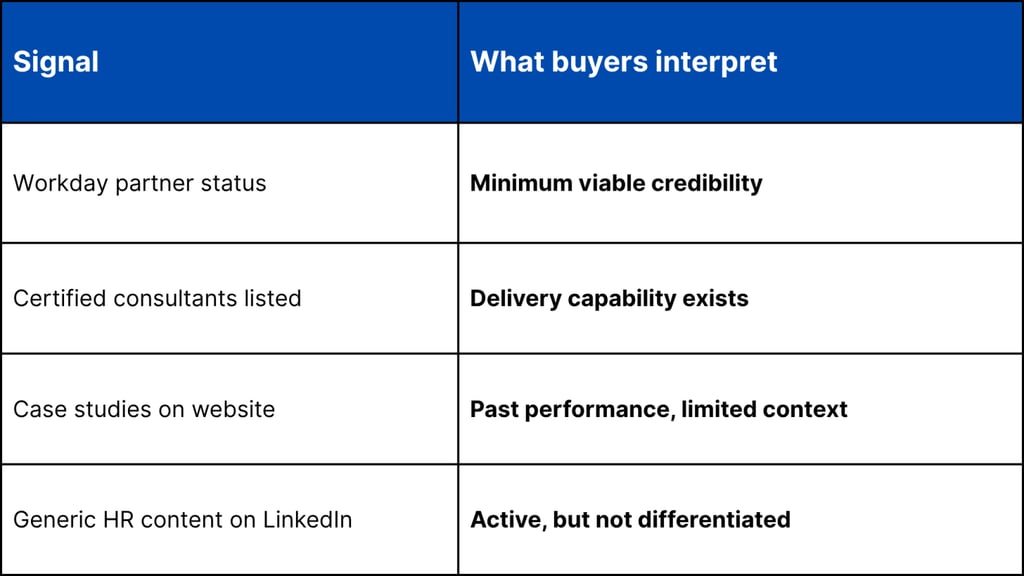
Workday partner status is table stakes. It is the minimum requirement to be considered, not the reason a firm gets chosen.
What actually separates firms in the minds of buyers is specificity demonstrated understanding of a particular sector, a particular scale of business, a particular transformation challenge. Buyers do not want a generalist Workday partner who can theoretically handle any engagement. They want a firm that appears to have already solved their problem.
This distinction matters because it changes what effective marketing looks like for a Workday consulting firm.
What Certification Signals
What Trust Actually Requires
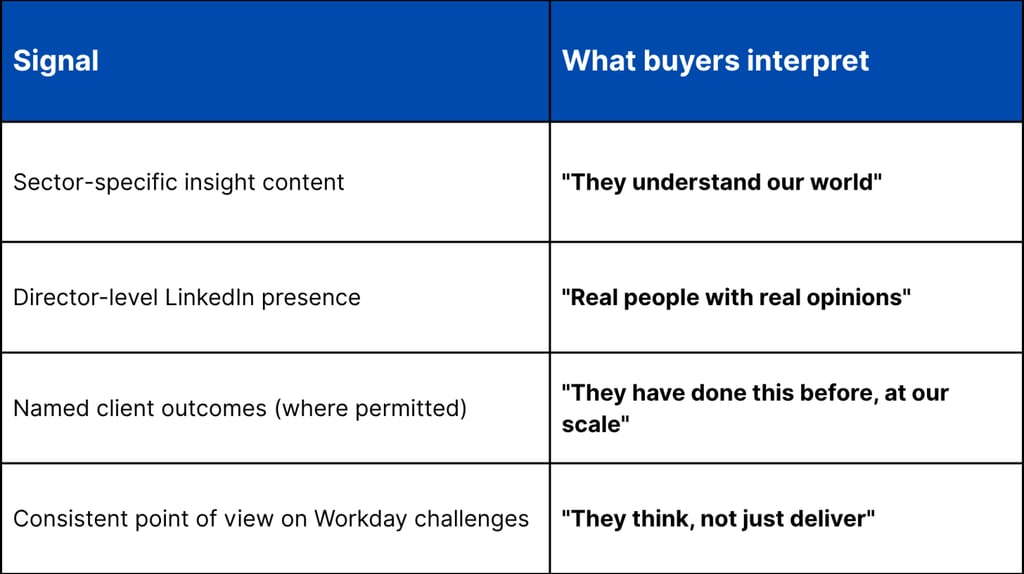
The shift from the left column to the right column is not a branding exercise. It is a positioning exercise. It requires a firm to make a choice about who it is for and what it specifically knows and then to make that visible, consistently, over time.
Most Workday firms avoid this choice because specificity feels like it narrows the market. In practice, it does the opposite. Buyers shortlist firms that appear to understand them. Generalist positioning does not broaden your appeal to senior buyers it registers as undifferentiated and triggers caution.
The Visibility Gap
The firms winning the accounts they should be winning are not necessarily better at delivery. They are more visible in the right places, with the right specificity, at the right time. That visibility is not accidental. It is built deliberately, through consistent positioning and content that reflects genuine expertise rather than marketing activity.
A Framework For Building Buyer Trust Before Contact
The following framework is not a content calendar or a LinkedIn tips list. It is a structured approach to the question that actually determines whether a Workday consulting firm gets shortlisted: does the right buyer, in the right account, trust this firm enough to start a conversation?
Step 1: Define your anchor accounts, not your total addressable market
Identify twenty to thirty accounts where your firm has the strongest right to win based on sector experience, implementation history, and the specific Workday modules you know best. These are not leads. They are the accounts where your positioning should be doing active work. Everything else follows from this list.
Step 2: Audit what those buyers currently see
Before building anything, understand what a buyer at one of your anchor accounts would find if they searched your firm's name, your directors' names, and the Workday challenges relevant to their sector. What is the composite picture? Is there a clear point of view? Is there evidence of sector expertise? Is there a reason to trust? Most firms who conduct this audit find the answer is no.
Step 3: Build visible expertise at director level, not company level
Firm pages carry limited trust in the Workday buying context. Buyers want to know who they will actually be working with. Director-level LinkedIn presence genuine, consistent, and specific carries disproportionate weight in the research phase. This does not mean personal branding content. It means directors sharing real perspectives on real Workday challenges in specific sectors.
Step 4: Create content that reflects the buyer's problem, not the firm's capability
The question a buyer is asking is not "what can this firm do?" It is "does this firm understand what I am trying to solve?" Content that answers the second question builds trust. Content that answers the first question builds awareness, at best. The distinction is between insight-led content and promotional content and buyers can tell the difference.
Step 5: Sustain the signal over time
A single strong piece of content does not change a firm's perceived position. A consistent body of work, published over months, does. Buyers who encounter a firm repeatedly in their feed, through their network, through a newsletter form a different level of trust than buyers who see a firm once. Frequency and consistency are the mechanics of positioning. There is no shortcut.
Conclusion
Certification earns a firm the right to be evaluated. Trust earns a firm the right to be chosen. These are not the same thing, and confusing them is the most expensive mistake a Workday consulting firm can make in a competitive market.
The firms building durable pipeline are not outspending competitors on marketing or outworking them on outreach. They are outpositioning them by being specific, visible, and consistent in the places where buyers conduct their silent research. That is a slower build than a campaign. It is also a far more reliable one.
Are you a founder or director of a Workday consulting firm? The Workday LinkedIn Audit is a structured diagnostic that assesses whether your firm's current LinkedIn presence is working in your favour during active buying decisions or quietly working against you. It is available to a limited number of firms where there is a genuine fit. If that sounds relevant, it is worth a conversation.