
By The Time A Workday Buyer Contacts You, The Decision Is Nearly Made
The problem no one names in the pipeline meeting
There is a pattern that repeats itself across Workday consulting firms every quarter. A mid-market HR Director at a 3,000-person UK manufacturer reaches out. They seem engaged. The discovery call goes well. Two further conversations happen. Then silence.
Three months later, you hear through a contact that they signed with a competitor.
What nobody says in the post-mortem is this: the decision was not made during those three conversations. It was made weeks before the first one. By the time that HR Director sent the initial message, your firm was already being evaluated against a shortlist that had formed without your knowledge, without your input, and entirely on the basis of what they found when they looked you up.
This is the pattern that most Workday consulting firms are still not accounting for. They invest in outreach, proposals, and sales conversations. They rarely invest in the environment where actual shortlist decisions are being made.
That environment is not a procurement portal. It is LinkedIn. And it is running quietly, continuously, long before any buyer announces intent.
How Workday buyers actually research
The Workday buying cycle at mid-market and enterprise level is long, consensus-driven, and heavily front-loaded with silent research. HR Directors, CFOs, and Heads of Finance do not begin evaluating partners when they issue an RFP or take an introductory call. They begin months earlier, through informal due diligence that leaves no trace.
LinkedIn functions as the primary due diligence tool in this phase. A 2023 LinkedIn B2B Institute report found that 78% of B2B buyers use LinkedIn to research vendors before any contact. In high-trust, high-investment categories like enterprise HR transformation, that number skews higher. Workday implementations carry six-figure fees and multi-year organisational consequences. Buyers are not casual.
What they are looking for in this research phase is not capability. They assume capability at the shortlist level. What they are assessing is credibility, perspective, and cultural fit. They want to know whether the people at this firm understand the complexity of what they are being hired to do. They want signals that distinguish considered expertise from generic service delivery.
Edelman's 2024 B2B Thought Leadership Impact Report found that 61% of C-suite executives are willing to pay a premium to work with firms whose thought leadership they find credible. More relevant still: 48% said that poor or generic thought leadership caused them to remove a firm from consideration. Not ignore it. Remove it.
These decisions happen before the first conversation. They happen on your LinkedIn profile, your team's activity, and the content your firm puts into the feed of the people you most need to reach.
The Core Insight: Sana changes what buyers expect from implementation partners
In March 2026, Workday announced that Sana from Workday described as superintelligence for work is now available to customers worldwide, including Sana for Workday as a new AI interface, the Sana Self-Service Agent which automates HR and finance workflows, and Sana Enterprise which extends AI capabilities beyond Workday itself.
This is not a feature update. It is a repositioning of what Workday is. Workday Co-Founder and CEO Aneel Bhusri framed it directly: "AI only works in the enterprise when it's connected to trusted, deterministic systems, and that hybrid architecture is exactly what Workday is building."
For Workday consulting firms, this shift has a specific and immediate implication. Your buyers HR Directors, CFOs, Heads of Finance are now navigating a product that is materially more complex and more strategically significant than it was eighteen months ago. Sana Self-Service Agent already has 400 customers in the early adopter group and covers more than 300 skills that can dramatically change human workflows through automated processes across Workday.
This creates a new question in every buyer's mind when they look at a Workday consulting firm: does this partner understand what Workday is becoming? Not what it was at last year's implementation. What it is becoming.
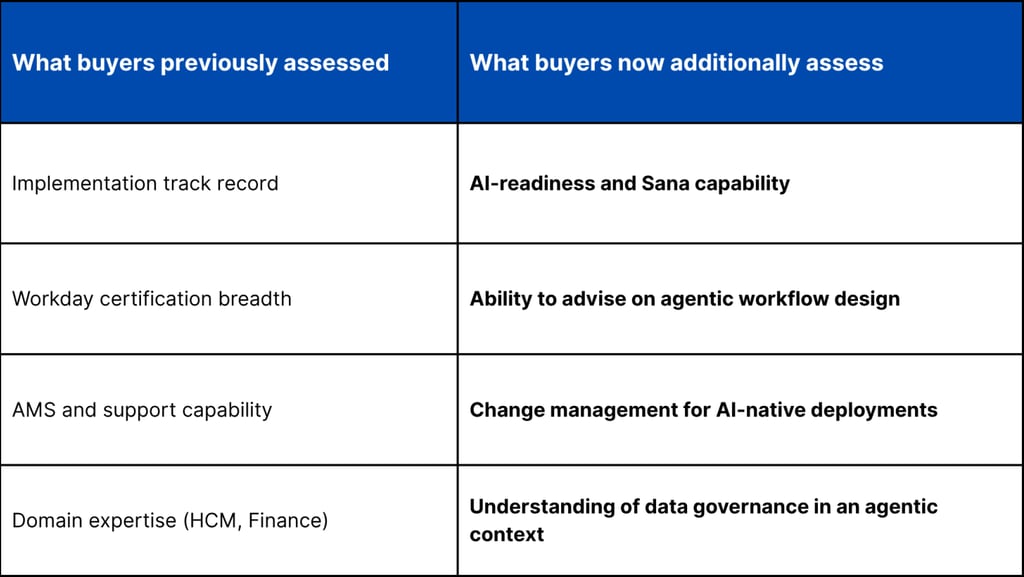
The firms that are already publishing content that reflects this shift calmly, specifically, without hype are the ones being placed on shortlists right now. The firms that are still posting about implementation methodology and certification badges are being quietly filtered out. Not rejected. Simply not included.
Workday implementation partner Agilysys is noted directly that realising the value of Sana and Workday's combined capabilities "requires thoughtful planning and expertise," and that the opportunity for organisations is enormous but dependent on a partner who can design, deploy, and optimise the new AI capabilities effectively.
That framing is the opportunity. The buyer is asking whether you are that partner. Before they ask you directly, they look.
The practical framework: the Consideration Window
Most Workday consulting firms think about pipeline in terms of deals: opportunities that are open, in progress, or closed. This is the wrong frame.
The more useful frame is the Consideration Window: the period during which a buyer is silently evaluating whether your firm belongs on their shortlist. This window opens months before any formal engagement. It closes quietly when the buyer makes a provisional decision. By the time they contact you, the window is often already closing.
Your job is not to be visible when the buyer contacts you. Your job is to be visible, specific, and credible while the Consideration Window is open.
Here is a structured approach to doing that consistently:
Step 1: Map your target accounts and their decision timeline.
Identify 20 to 30 organisations in your ICP where a Workday implementation, upgrade, or AI readiness review is plausible in the next 12 to 18 months. These are the accounts whose Consideration Windows you need to be present in right now.
Step 2: Identify the three to five individuals at each account whose LinkedIn activity you need to appear in.
This is not about connecting with them. It is about producing content that reaches them organically through their network and their interest graph. HR Directors and CFOs follow Workday, follow industry analysts, and engage with content that addresses their operational pressures. That is where you need to be present.
Step 3: Produce content that reflects where Workday is going, not where it has been.
Workday's own blog documented that after rolling out Sana internally in 60 days, it reached 80% of its 21,000 employees, with more than 12,200 active users each week and that a custom legal agent transformed a 1,500-contract review from a 9,000-hour project into a streamlined success. These are the real-world signals your buyers are reading. Your content should reflect that you understand the implications for HR and Finance transformation, not that you have read the press release.
Step 4: Make your firm's point of view visible at the leadership level.
Buyers do not shortlist firms. They shortlist people they trust, who happen to represent firms. The founders and senior directors of Workday consulting firms who are consistently visible on LinkedIn with a clear, credible perspective on the direction of the platform are the ones whose firms appear on shortlists before a single outbound message is sent.
Step 5: Track engagement signals, not vanity metrics.
Profile visits from HR Directors and CFOs at target accounts are more meaningful than post likes. Newsletter subscribers from your ICP are more meaningful than follower counts. Build the habit of reading your engagement data as pipeline intelligence, not content performance.
Growth Is a Strategy Choice
The Workday market is shifting faster in 2026 than it has in several years. The Sana launch is not a distant R&D signal. It is live, it is in the hands of 400 early adopter customers, and it is already changing what buyers expect from implementation and AMS partners.
The firms that will win the next cycle of significant Workday engagements are not necessarily the ones with the largest teams or the deepest certification list. They are the ones whose buyers already trust them because they have been present, specific, and consistent in the environment where trust is formed. That environment is not a sales call. It is a LinkedIn feed, a newsletter, and a quiet shortlist that forms long before you are invited to pitch.
If you are the founder or director of a Workday consulting firm and you are unsure whether your LinkedIn presence is working for or against you in active buying cycles, the Workday LinkedIn Audit is a structured diagnostic designed for firms at exactly this stage. It is not a free resource for everyone. If you would like to understand whether it is relevant to your firm, feel free to message directly.