
AMS Is Easier To Sell Than Implementations Most Workday Firms Just Don't Know It Yet
Why the firms doing the most implementation work often have the emptiest pipelines
There is a particular kind of Workday consulting firm that is technically excellent and commercially fragile at the same time.
They win implementations. Good ones. Clients are satisfied. Hypercare runs clean. But when the project closes, the firm returns to the same problem it had twelve months ago: an empty pipeline and a team with capacity coming free in six weeks.
The founder is back on LinkedIn. Back reaching out. Back reminding contacts they exist.
This is not a business development problem. It is a positioning problem. And it is almost entirely avoidable, because these firms are sitting on an asset they have not learned to monetise: their post-go-live relationships.
AMS is not a consolation prize after an implementation. Positioned correctly, it is the most commercially predictable, buyer-friendly, and referral-generating service a Workday consulting firm can offer. The firms that understand this are not chasing the next project. They are building a business.
The question worth asking is not whether your firm offers AMS. Most do, as an afterthought. The question is whether your AMS is positioned clearly enough to create pipeline on its own before you ever speak to a prospect.
What buyers are doing before they ever reach out
The Workday buyer typically a HR transformation director, CFO, or VP of HR does not begin their vendor search by filling in a contact form. They begin somewhere far quieter: a LinkedIn search, a Google query, a peer recommendation in a network they trust.
According to the Edelman-LinkedIn B2B Thought Leadership Impact Study, 58% of senior decision-makers use thought leadership content to shortlist vendors before making first contact. Gartner's B2B buying research confirms that buyers complete 57–70% of their decision journey before speaking to any vendor. By the time a Workday buyer has opened a conversation with your firm, they have already formed a view.
The signals they look for during this silent research phase include: does this firm understand my industry, does their leadership communicate with clarity, do they appear to work with organisations similar to mine, and critically do they look like they stay involved after go-live or do they disappear when the invoice is paid?
That last signal is where AMS positioning does its quiet work. A firm whose LinkedIn presence, website, and content consistently communicates stability, continuity, and post-implementation depth reads differently to a buyer than a firm who leads exclusively with project wins. One feels transactional. The other feels like a long-term partner.
Buyers are not consciously running this comparison. But they are forming the impression. And it shapes who gets invited to a conversation.
Why AMS is structurally easier to sell and why most firms miss it
The central insight here is not about marketing tactics. It is about how buyers make purchase decisions at each stage of the engagement cycle.
Implementations carry high perceived risk
When a Workday buyer is evaluating an implementation partner, they are making a multi-year, multi-hundred-thousand-pound decision based on limited direct evidence. They are assessing team depth, methodology, delivery track record, and cultural fit none of which are easy to verify. The sales cycle is long, the proof requirements are high, and the buyer's caution is justified.
AMS carries a fundamentally different risk profile
An AMS contract is typically structured with monthly or quarterly payment terms, a defined scope of support, and a shorter initial commitment. The buyer already knows Workday is live. They know what they need. The question is not "can this firm implement Workday" that proof requirement is gone. The question is "can this firm keep things running and support our team when it matters."
That is a much lower bar to clear.
The comparison below illustrates the structural difference:
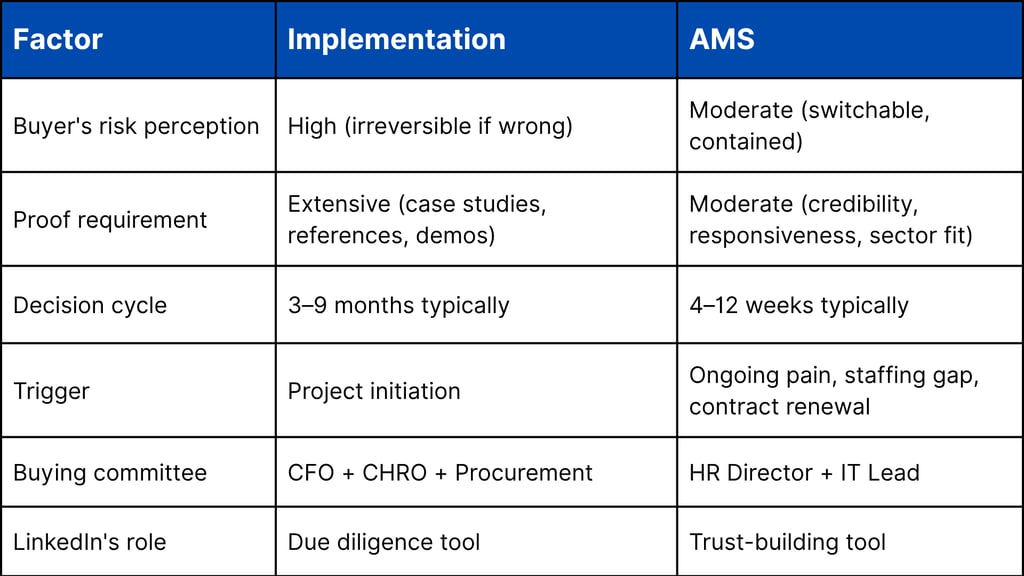
The implications are significant. If your firm leads with AMS as a primary commercial offer not a follow-on service, but a positioned, visible, named service with a clear value proposition you are speaking to a buyer who is already further along in their readiness, facing a lower internal approval threshold, and making a decision on a shorter timeline.
That is not easier marketing. That is a better-positioned service meeting a buyer with genuine urgency.
The AMS Positioning Framework: four decisions your firm needs to make
Most Workday firms offer AMS without positioning it. They name it on a services page, quote for it reactively, and treat it as what happens after the implementation. That is leaving pipeline on the table.
Here is a structured way to think about repositioning AMS as a pipeline-generating offer:
Step 1: Name the problem your AMS solves, not the service itself
"Managed support and application services" is a category. "Keeping your Workday investment performing after your system integrator leaves" is a problem. Buyers search for the second. Position toward the problem your buyers are actually experiencing: internal team gaps, consultant dependency, upcoming reporting cycles, failed upgrades, integration drift.
Step 2: Define your ideal AMS client with genuine specificity
Not "organisations running on Workday." That is everyone. The firms generating consistent AMS pipeline can describe their best client in 30 seconds: sector, Workday module footprint, headcount range, typical trigger for engagement. Specificity creates recognition. Recognition creates inbound enquiries.
Step 3: Make your post-implementation capability visible before go-live
Your LinkedIn content, your founder's commentary, your newsletter these should speak about the post-go-live world: what goes wrong, how support models work, what good AMS actually looks like. Buyers researching their next implementation are also thinking about what comes after. Influence that thinking early.
Step 4: Separate the AMS conversation from the implementation conversation
Too many firms bundle these. They say: "we implement Workday and we also offer AMS." That framing makes AMS feel like an afterthought. Consider whether your AMS offer can stand alone commercially with its own messaging, its own proof points, and its own entry point for buyers who are not in an implementation cycle at all.
Firms that do this well are not selling AMS as an add-on. They are running two parallel pipelines, and one of them never stops generating.
The compounding effect most firms are not capturing
There is one more dimension to AMS positioning that rarely gets discussed: its compounding commercial value.
An AMS client who trusts your firm is not just a retainer. They are a reference, a case study, a referral source, and a future re-implementation client. Because they are staying current on Workday releases with your support, they are also more likely to identify the next project internally and to bring you into it before a competitive process begins.
The firms generating the most predictable Workday pipeline are not necessarily the ones with the largest implementation track records. They are the ones who have built visible, trusted AMS practices and used those relationships to stay in the room.
Implementation wins you a project. AMS wins you a relationship. And in professional services, relationships are the pipeline.
Your Next Step
If your firm offers AMS but cannot point to a consistent pipeline of inbound AMS enquiries, the issue is almost certainly positioning rather than market demand.
If that sounds worth an hour, click the button below.